Buying guides
Boltless Rack vs Bolted Shelving: Which Is Better for Your Business?
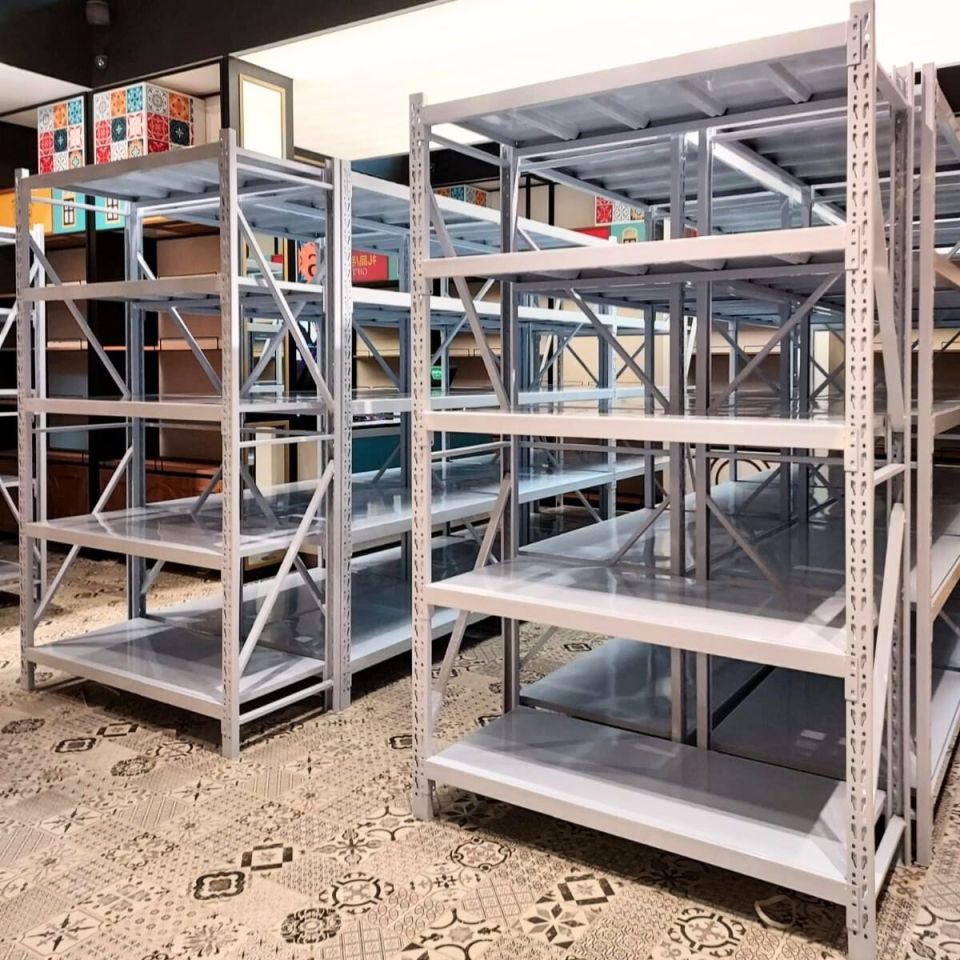
Search for a boltless rack in Singapore and you will also find plenty of bolted angle-iron shelving at similar prices. Both are metal steel racks, both hold boxes — so does the connection method really matter? For a business, it matters a lot. Here is an honest comparison.
How each system goes together
Bolted shelving uses perforated angle uprights. Each shelf is attached at the four corners with nuts and bolts — typically sixteen fixings per shelf, and a spanner for every one.
Boltless racking uses uprights with a row of slots. Each beam has hooks or rivets on its ends that drop into the slots and wedge tighter as weight goes on. Shelf panels sit on the beams. A rubber mallet is the only tool.
Assembly time
A single bolted bay with five shelves can take an hour or more to assemble and square up. A boltless bay of the same size goes up in a fraction of that time. On a commercial project of twenty or thirty bays, the difference is a full day of labour — and a day less disruption to your business.
Strength
Strength depends on steel thickness and design more than the fixing method. That said, typical bolted angle shelving is rated for light loads per shelf, because the corner bolts and thin angle steel are the weak point. Boltless systems spread the load along a formed beam into the full upright, which is why medium-duty boltless racks like our warehouse rack can carry 400kg per level, and even our lighter boltless rack is rated at 200kg per level.
Flexibility
This is where boltless racking wins outright. Businesses change: a new supplier ships taller cartons, a new product line needs more, shallower levels, a lease ends and you move across the island. With a boltless rack, you lift a beam out and drop it into a different slot. With bolted shelving, you unscrew sixteen bolts per shelf — and the holes rarely line up exactly where you want them.
Safety and stability
Bolts can loosen over time, especially where racks are knocked by trolleys. Boltless beams lock more tightly the more they are loaded. Look for details that add rigidity — our boltless rack, for example, uses welded side frames and deep butterfly-shaped slots, and stands on flat base plates with rubber pads that protect the floor.
Cost
Bolted angle shelving often looks cheaper on a price list. Once you add the time to assemble it, the lower load per shelf (which means more bays to hold the same stock) and the cost of reconfiguring later, a boltless rack is usually the better value for a business.
When bolted shelving still makes sense
- Very light loads that will never change, such as a small home cupboard.
- Where you need a shelf at an unusual, non-standard height.
- Bespoke frames built into a vehicle or a machine.
For warehouses, F&B stores, retail stockrooms and offices, boltless is the default for good reason.
Summary
| Factor | Boltless rack | Bolted shelving |
|---|---|---|
| Assembly | Mallet only, fast | Spanner, many fixings |
| Typical load per level | 200–400kg+ | Light |
| Re-spacing shelves | Seconds | Unbolt and re-bolt |
| Relocation | Easy | Slow |
| Best for | Commercial and industrial use | Light, fixed storage |
Not sure which suits your space? See how we plan for your industry on our solutions page.
Planning racking for your business? Send us your floor plan and we will design the layout and quote it for free — usually within one working day.